


A Biography of Xuanzang (English-Chinese Edition): The Monk Who Walked to India, in Ten Scrolls
A Biography of Xuanzang (English-Chinese Edition): The Monk Who Walked to India, in Ten Scrolls
- 99% Issue-Free
- Secure Checkout
- $10K ID Protect
Security & Service
- Payment
Security - Privacy
Protection - Efficient
Shipping - Customer
Support



Detail


 What Is This Book About?
You may know the Tang Monk from Journey to the West. But do you know who the real Xuanzang was?
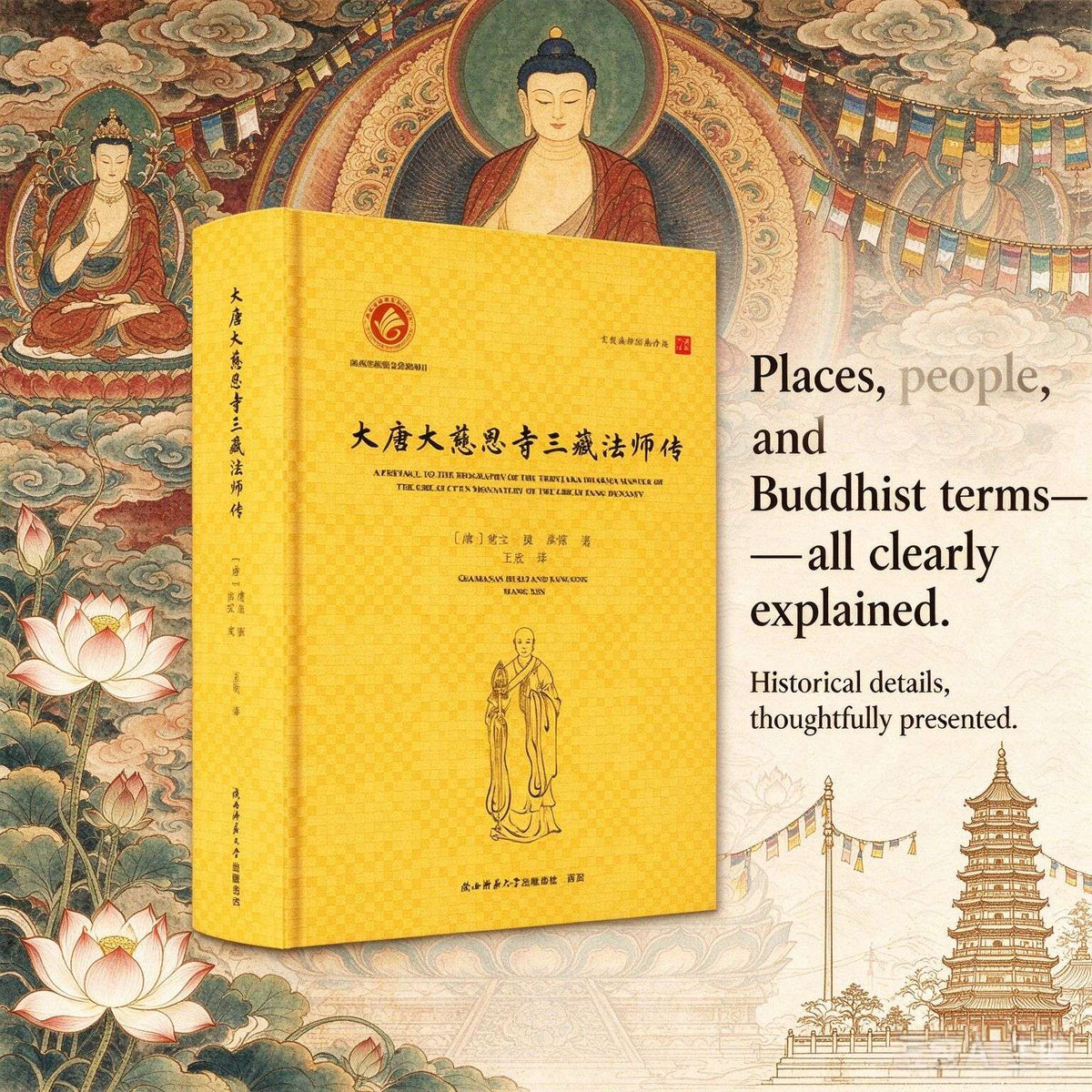
The Biography of the Tripitaka Master of the Great Ci'en Monastery was written after Xuanzang's death by his two disciples, Huili and Yancong, based on Xuanzang's own oral accounts. The book has ten volumes: the first five document his journey from Chang'an through the Western Regions and Central Asia to Nalanda Monastery in India — including getting lost in the desert, being detained by the King of Gaochang, and debating scholars across India. The last five volumes cover his return to Chang'an, his translation work, and his relationship with Emperors Taizong and Gaozong.-13
This biography and The Great Tang Records on the Western Regions are considered companion works, together forming the most essential primary sources for studying Xuanzang's life and the history and geography of 7th-century Central Asia and India. Liang Qichao once called it "the most valuable of all biographies of famous figures, ancient or modern."-
Why Should You Read It?
If you love history: This book offers firsthand geographical, ethnographic, and religious records of 7th-century Central Asia and India — more valuable than any secondhand account.
If you study or practice Buddhism: This is a disciple's own record of their master's life, filled with details about Xuanzang's spiritual practice, translation process, and conversations with emperors.
If you're learning English: This is a bilingual Chinese-English edition. The Chinese text preserves classical elegance while the English translation aims for clarity and readability, with over a thousand annotations throughout.-13Reading a book with real substance is worth more than ten ordinary English readers.
If you're fascinated by the Silk Road: Xuanzang walked the core routes of the Silk Road. His records of the city-states, customs, and languages along the way are among the most vivid materials available for understanding the ancient Silk Road.
Why This Edition?
Authoritative source text + scholarly translation. Based on the Zhonghua Book Company punctuated edition, translated by Wang Xin — a PhD in World History and Distinguished Research Fellow at Northwest University's Xuanzang Institute.-13The translation was carefully researched and refined to preserve the elegance of the classical Chinese while ensuring accurate, fluent English.
Over 1,000 annotations. Historical place names, figures, Buddhist terminology, and institutional details are explained one by one, making the book accessible to both Chinese and English readers.
Hardcover collector's edition. 32-format hardcover, 836 pages, printed on offset paper — built for repeated reading and long-term keeping.
Part of a series. This book belongs to the "Xuanzang Master Classics Translation Series," which also includes The Great Tang Records on the Western Regions (bilingual edition). Funded by the Shaanxi Publishing Fund, the series systematically translates Xuanzang's classic works into English.
-
101 Stories for Foreigners to Understand Chinese People (English Edition): Real-Life Lessons on Culture, Etiquette & Getting It Right
Regular price £21.80Regular price£31.00Sale price £21.80DEAL -

24 Solar Terms (English-Chinese Edition): 24 Art Postcards Where Chinese Characters Come to Life
Regular price £19.70Regular price£28.00Sale price £19.70DEAL -
24 Solar Terms Fairy Tale (English-Chinese Edition): A Little Prince‘s Journey Through the Four Seasons
Regular price £18.30Regular price£26.00Sale price £18.30DEAL -
300 Song Lyrics (Chinese-English Edition): Xu Yuanchong’s Translation of Classic Ci Poetry
Regular price £21.80Regular price£30.90Sale price £21.80DEAL -
300 Tang Poems (Chinese-English Edition): Xu Yuanchong’s Rhymed Translation of the Golden Age
Regular price £21.00Regular price£30.00Sale price £21.00DEAL -
300 Yuan Songs (Chinese-English Edition): Xu Yuanchong‘s Translation of Classic Sanqu Poetry
Regular price £21.40Regular price£30.50Sale price £21.40DEAL -
80000 Words English-Chinese / English-English / Chinese-English Dictionary (Two-Color Edition): A Three-in-One Reference for Learners
Regular price £23.40Regular price£33.50Sale price £23.40DEAL -
A Bing Xin Reader (English Edition): Letters to Young Readers & The Little Orange Lamp
Regular price £21.90Regular price£35.00Sale price £21.90DEAL -

A Biography of Xuanzang (English-Chinese Edition): The Monk Who Walked to India, in Ten Scrolls
Regular price £23.50Regular price£34.00Sale price £23.50DEAL -
A Brief Introduction to the Belt and Road Initiative (English Edition): 111 Questions Answered in Plain English
Regular price £25.00Regular price£0.00Sale price £25.00


